
"one million coffee beans"
7000 article(s) found

Where will Yunnan Coffee Industry go?
Recently, coffee industry in Yunnan Province has become a hot topic that people pay close attention to. On the one hand, the coffee planting area in Yunnan Province reached a new high of 1.3 million mu; on the other hand, the coffee purchase price of Nestl é in Yunnan fell to nearly 17 yuan / kg, a five-year low. Where will Yunnan coffee industry go? In view of the above, the Yunnan Coffee Association recently held a media meeting to outline

Introduction to the description of the grinding degree, taste and flavor of Costa Rican Yerzaro coffee with good sweetness
Costa Rica accounts for only 0.03% of the world's land area, but with nearly 4% of the world's species, Costa Rica is one of the countries with the richest biological species in the world. 26% of the land area is a national park or nature reserve, including 11 wetlands, 2 biological reserves and 3 World Natural Heritage sites. The national forest coverage rate is 52%. Natural resources include iron, manganese, mercury, bauxite,

Costa Rican Yelsalo Coffee with Good Sweetness Grindness Taste Characteristics Flavor Characteristics Aroma Simple
Other types of Brazilian coffee, such as Rio, Parana, etc., can be produced in large quantities without too much care. Although the taste is rough, it is a kind of inexpensive coffee. Because it is distributed all over the country, the solid quality varies, and there are its own standards (NO.2~NO.8 according to the amount of impurities, NO.13~NO.19 according to the size of beans, divided into six grades according to taste).

Ecuador Coffee Flavor Taste Variety Production Characteristics Fine Coffee Bean Introduction
Western coastal areas: including coastal plains and foothills, east high west low, generally below 200 meters above sea level, there are some hills and low mountains 600~700 meters above sea level. Tropical rain forest climate, the southernmost start to transition to a savanna climate. The annual average precipitation decreases from more than 3000 mm to about 500 mm from north to south. The Andes range from Colombia to Ecuador.

Introduction of Costa Rican Yerzaro Coffee Flavor and Taste varieties
Costa Rica accounts for only 0.03% of the world's land area, but with nearly 4% of the world's species, Costa Rica is one of the countries with the richest biological species in the world. 26% of the land area is a national park or nature reserve, including 11 wetlands, 2 biological reserves and 3 World Natural Heritage sites. The national forest coverage rate is 52%. Natural resources include iron, manganese, mercury, bauxite,
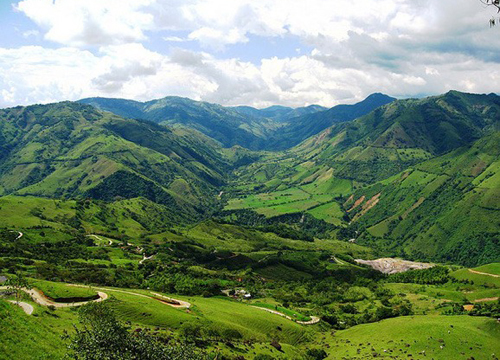
Brazilian Coffee Industry Brazilian Coffee production areas learn about Brazilian Coffee Industry
Coffee industry in Brazil Coffee is a traditional industry in Brazil. Since 1960, coffee cultivation in Brazil has been ranked first in the world, with an average annual output of 24.6 million bags (60 kg each). In 2002, due to favorable weather and a good year for coffee production, Brazilian coffee reached the best level in history, reaching 47.2 million bags, an increase of 59.6 per cent over 28.137 million bags in 2001. According to the United States Department of Agriculture 20
The strong scented Costa Rican Yerzaro boutique coffee bean cultivation situation, geographical location, climate sea
There are many kinds of coffee here, but its industrial policy is large and cheap, so there is not much premium coffee, but it is a good choice for mixing other coffees. The newly developed villa sarchi planting, breeding and quality inspection research institutions, in addition, it also has 10 hectares of experimental plots, planting a number of excellent varieties. Coffee is the main agricultural product in Costa Rica, with an annual output of more than 2 million.

Introduction to the characteristics of coffee flavor and taste of Costa Rica's Saint Roman Manor
Costa Rica accounts for only 0.03% of the world's land area, but with nearly 4% of the world's species, Costa Rica is one of the countries with the richest biological species in the world. 26% of the land area is a national park or nature reserve, including 11 wetlands, 2 biological reserves and 3 World Natural Heritage sites. The national forest coverage rate is 52%. Natural resources include iron, manganese, mercury, bauxite,

Costa Rica Yellow Honey Coffee Bean Flavor Description Grind Scale Variety Taste Treatment Introduction
Coffee was introduced to Costa Rica from Cuba in 1729, and today its coffee industry is one of the most well-organized in the world, producing up to 1700 kilograms per hectare. Costa Rica has 400 million coffee trees among a population of 3.5 million, and coffee accounts for 25 percent of the country's exports

How does African coffee get to all parts of the world?
How coffee from Africa was shipped to all parts of the world at the beginning of the 20th century, Brazil accounted for more than 75% of the world's total coffee production, thus winning the reputation of the coffee kingdom. Coffee is one of the important pillars of Brazil's national economy. There are 500000 coffee plantations, large and small, covering an area of about 2.2 million hectares, with a working population of more than 6 million and an annual output of about 2 million tons of coffee.
History of Coffee planting in the World
Coffee production in China has experienced a tortuous course of development. From the 1950s to the early 1960s, coffee production had a peak period. In 1960, the planting area of the whole country reached 130000 mu, with an annual output of more than 300t.

Introduction to the description of the flavor of high-quality coffee beans in Costa Rican coffee producing areas
Tarrazu in Costa Rica is one of the major coffee producing areas in the world. The coffee produced is light and pure in flavor and pleasant in aroma. Costa Rica, with its fertile volcanic soil and good drainage, is the first country in Central America to grow coffee and bananas for commercial value. Coffee and bananas are the country's main exports. In 1729, coffee was introduced from Cuba to Goth.

Introduction to Brazilian Coffee Flavor and Taste Brazilian fine coffee beans in Brazilian coffee producing areas
The topography of Brazil is mainly divided into two parts, one is the Brazilian plateau above 500 meters above sea level, distributed in the south of Brazil, the other is the plain below 200 meters above sea level, mainly distributed in the north of the Amazon River basin and the west. The topography of the whole territory is divided into Amazon plain, Paraguay basin, Brazilian plateau and Guyana plateau, of which the Amazon plain accounts for about 1% of the national area. Yes

Introduction to the characteristics of coffee flavor and taste of Costa Rica's Saint Roman Manor
The topography of Costa Rica is that the coast is surrounded by plains, while the middle is cut off by rugged mountains. The country declared 200 nautical miles in its exclusive economic zone and 12 nautical miles in its territorial sea. The climate belongs to the tropics and subtropics, and some of them are new tropics. [3] the climate of Costa Rica is so different that it completely subverts the classification of the four seasons of the year. There are only two seasons, April to December.

Costa Rica Goddess Manor introduces Coffee Variety producing area Manor
Costa Rica is located in the Central American isthmus, belonging to North America, 10 north latitude, 84 west longitude. It is bordered by the Caribbean Sea to the east and the North Pacific Ocean to the west, with a coastline of 1290 km (212km on the east coast and 1016 km on the west coast). Costa Rica borders Nicaragua in the north (309 km long border) and Panama (639 km long border) south-southeast. Total

Introduction of boutique coffee beans in Costa Rican Yerzaro coffee producing area
Costa Rica is located in the Central American isthmus, belonging to North America, 10 north latitude, 84 west longitude. It is bordered by the Caribbean Sea to the east and the North Pacific Ocean to the west, with a coastline of 1290 km (212km on the east coast and 1016 km on the west coast). Costa Rica borders Nicaragua in the north (309 km long border) and Panama (639 km long border) south-southeast. Total

Free Starbucks? Starbucks Christmas marketing loophole! He was masturbated 10 million by econnoisseur!
Professional coffee knowledge exchange more coffee bean information please follow the coffee workshop (Wechat official account cafe_style) at 11:31 this morning, a well-known earning website exposed: "Starbucks new users sign up for a free cup, one cup, currently unlimited mobile phones", in order to attract people's attention, the author specially marked the title urgent. At 11:40, some netizens in the wool group also began.

Uganda Coffee beans are expected to be exported to China in large quantities.
Uganda's coffee exports in June 2021 were 618388 bags of 60 kg bags worth US $58.56 million, the highest in a single month since 1991. This includes 565449 bags of robusta coffee valued at $50.25 million and 52939 bags of Arabica coffee valued at $8.31 million, according to UCDA's monthly report in June 2021. In the same month as last year

Long aftertaste of Puerto Rican boutique coffee beans taste the characteristics of the manor area to introduce Laresyao
In history, sugarcane planting was the main industry, and post-industry surpassed agriculture to become the pillar of the economy. The five major economic sectors in the former San Juan new city are manufacturing, finance, insurance and real estate, other services, government agency expenditure and trade. The main industries include pharmaceuticals, electronics, petrochemical, food processing, textiles and clothing, etc. Tourism is also an important part of Poland's economy.

The strong flavor of Puerto Rican coffee describes the degree of grinding taste characteristics of high-quality coffee beans
Puerto Ricans are the general name of the residents of United States Puerto Rico in Central America and the Caribbean. There are about 3.4 million people (1979). Spanish and English are widely used. More Catholic. The earliest inhabitants of Puerto Rico were Arawak and Caribbean Indians. In 2012, whites of European origin accounted for about 73% of the population, mixed-race people accounted for 23%, and blacks accounted for 4%. There are more than 20,000 Americans and others.